
Radio Observatory in Europe
2024-25
CRTV Research and Analysis Unit
Major changes in recent years have facilitated the customization and diversification of radio content, reshaping the system as a whole. Thus, there has been a shift from the traditional radio market to a new audio-radio ecosystem characterized by a plurality of accesses, formats and devices. Consumers, increasingly demanding, have changed their habits, combining traditional linear consumption with de-linearized and on-demand experiences, becoming more protagonists of their own choices.
This has pushed operators, both public and private, to rethink business models and strategies in an increasingly multimedia key. In this framework, technology has acquired a decisive and enabling role: in FM, competition is between national and local broadcasters capable of reaching a certain reception area; in DAB+, it is limited to operators present on multiplexes reaching a certain national or local area; IP (Internet Protocol) measures itself with a crowded global market.
The arrival of global technological players (i.e. Alphabet, Apple, Amazon, Spotify) and the multiplication of streaming services with large libraries of audio content have raised several questions in terms of the visibility and accessibility of radio offers (prominence). The issue of hybridization, i.e. the need for the radio medium to be present and accessible on all platforms, in all forms – and usable through the widest range of devices – has become crucial, but it also brings an inherent risk of ‘fragmentation’, in the absence of an organic and broader vision by all stakeholders.
The car is still the most important listening environment in many markets, but it also represents a highly competitive arena for infotainment, where not only content owners, radio publishers, aggregators and streaming platforms compete, but also different technologies, such as FM, DAB+ and IP. Although hybrid systems prevail, several car manufacturers (e.g. Stellantis, Renault) have introduced extreme solutions with electric cars without car radios, relying exclusively on the IP system for radio reception via the smartphone’s Bluetooth.
Today, radio is hybrid and omni-channel, present on all platforms with a diversification of formats and content that increasingly extends to the world of video.
Historical Background: Birth and Development of the Public-Private Model. All the European countries analyzed (Big5) celebrated the centenary of the radio medium, dating back to the three-year period 1921-1924, and with one feature in common: in each territory, the first broadcasts always started in the autumn season between October and December.
The first radio broadcast in the United Kingdom occurred on November 14, 1922; in Germany, radio transmissions began in a year later (October 29, 1923), while in France they had already been launched since late 1921 (December 24, 1921) from the Eiffel Tower. In Italy, we must wait more than three years for the first radio broadcast (October 6, 1924), followed about a month later by the Spanish one (November 10, 1924). [1]
Political structures and economic frameworks, as well as World War II (particularly in some countries), have profoundly influenced the development of the medium, which is still based on a mixed public-private organizational model. Throughout its long history, British radio has had an extremely significant impact on society and culture, helping to shape radio communication both nationally and internationally.
The birth and development of the federal model in Germany was strongly influenced by World War II. Where the public system had to satisfy the so-called ‘basic needs’ of the population, private broadcasting represented a complementary service. In France, the advantages of radio technology immediately led to the establishment of a state monopoly regime, similarly in Italy, where however by an important local private sector context that arose in the 1970s.

Differently from the other 4 countries, in Spain, commercial radio developed before public radio.
In some cases, there were several transitions over the years before arriving at the current public structure, as in Italy and France.
Number and Size of the Offer. The number of radio broadcasters, especially in the local sector, in the Big(5) European markets is not easy and immediate to quantify given the numerous sources, often divergent and in other cases based on perimeters that are not comparable.
In 2024, according to the latest Ofcom data, there are around 800 radio broadcasters present on all major platforms in the UK, the local sector accounting for around 92%. National radios, both private and public (BBC), broadcasting in analogue (FM/AM) and digital (DAB/DAB+) modes, are just over 60 (65). The growth of terrestrial licenses and the development of digital, Internet and satellite radio services have been followed by a consolidation of the business in the hands of a limited number of large private companies.
In mainland France (France métropolitaine), the ARCOM authority reports almost 900 radio services authorized to broadcast in analogue (FM) with additional 210 in the overseas territories (France d’outre-mer), totalling more than 1,100 broadcasters. Limiting the count to mainland France, more than 800 broadcasters are local (89%), while the national ones, private and public (Radio France) are 26.
The reconstruction is even more complicated for other countries. In Germany, which is extremely fragmented in the different federal territories (Länder), the KEK database reports 582 radio/sound offers of which over 500 are private (88%). Of these, 498 (86%) operate locally and 105 broadcast in German. There are 311 stream radio stations, 36 national ones, of which 3 are public (Deutschlandradio).
In Italy, the local sector is highly populated and varied, exceeding, including the nationwide broadcasters (47 including the new generation DAB+ radios), of the number of 1,700 radios. In Spain, too, the number of radio stations is extremely rich and diverse, exceeding 2,000 among national (25), regional and municipal.
Public Service and Private Operators. All Big(5) European countries have a mixed public-private system that has gone through an evolution path, marked by various interconnected trends. In some cases, public broadcasters played a leading role in the emergence of the radio system, in others a secondary role compared to private.
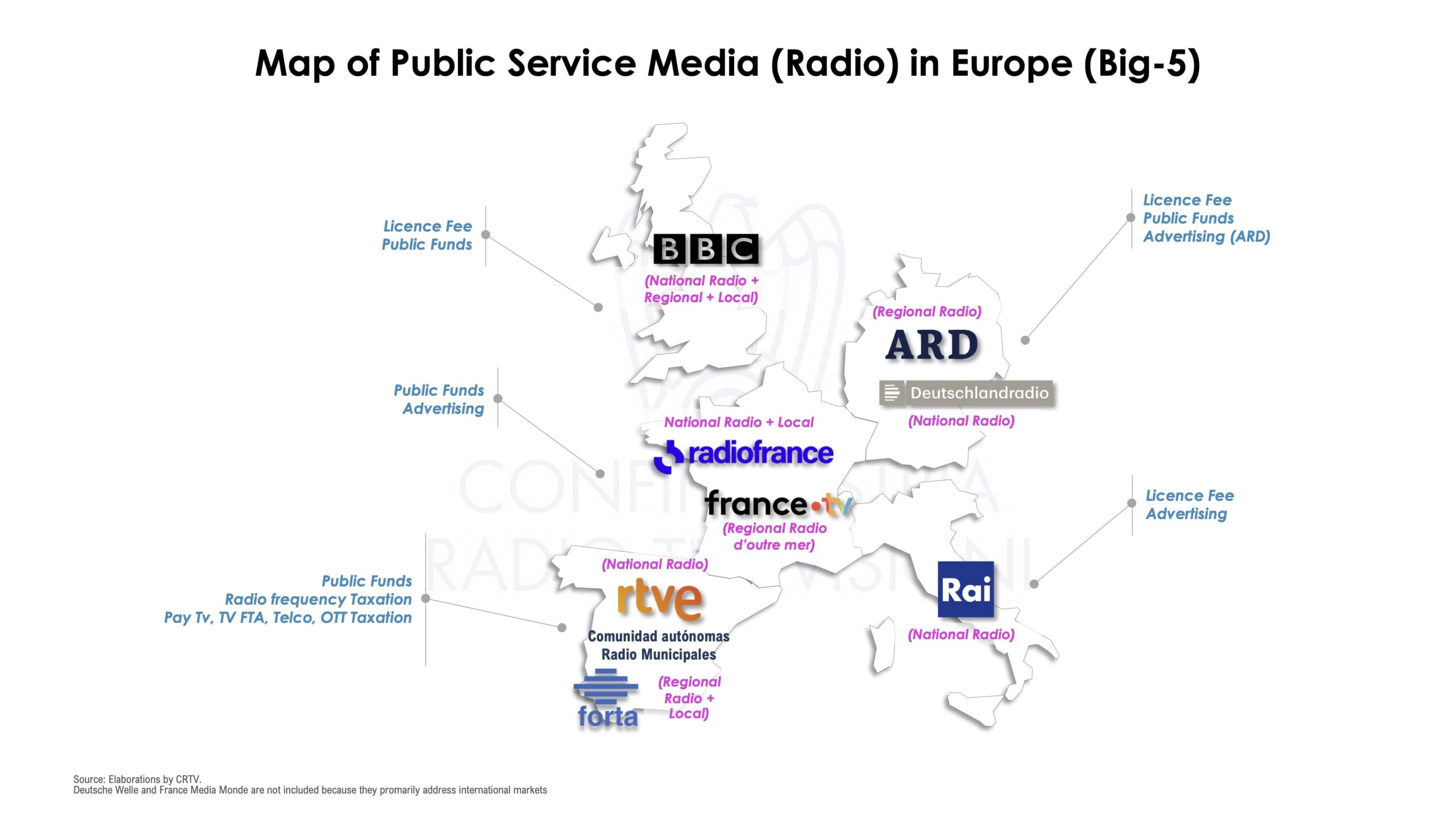
The explosion, between the 1960s and 1970s, of “pirate” radios and then “free” radios, led many public broadcasters to modernize their language and diversify and enrich their offer to compete with private radios and meet the demands of linguistic minorities and heterogeneous audiences. The local sector, depending on the administrative configurations and activities carried out by the ‘central’ MSPs, reflects different radio structures. Therefore, considering the differences between one country and another, it is possible to detect three main public service models:
- “Decentralized” model (Germany, Spain), when the public radio system, in addition to a central national presence, has a strong regional connotation: in Germany, the offer includes Deutschlandradio at national level (3 radios) and about sixty regional broadcasters (Länder) grouped together in ARD; in Spain, the autonomous regions are managed independently: alongside the operator RNE (4 national + one in Catalan) we find the regional broadcasters of the Comunidades Autónomas (30 radios) and the Municipales, controlled by the individual municipalities (500);
- “Mixed” model (UK, France), which has the bulk of the offer at national level, but, is also characterized by a plurality of local broadcasters: the BBC offer proposes, alongside the national networks, a series of regional radio stations and local broadcasters (BBC Radio Nations and BBC Radio Local with 52 radios); the French public model, managed by Radio France, consists of national channels and local broadcasters grouped under ICI-ex France Bleu (44) in mainland France. France Télévisions operates in overseas France with the La Première network (9 radio channels);
- Classic “centralist” model (Italy), characterized by the absence or marginal presence of broadcasters entirely dedicated to regional or local programming. [2]
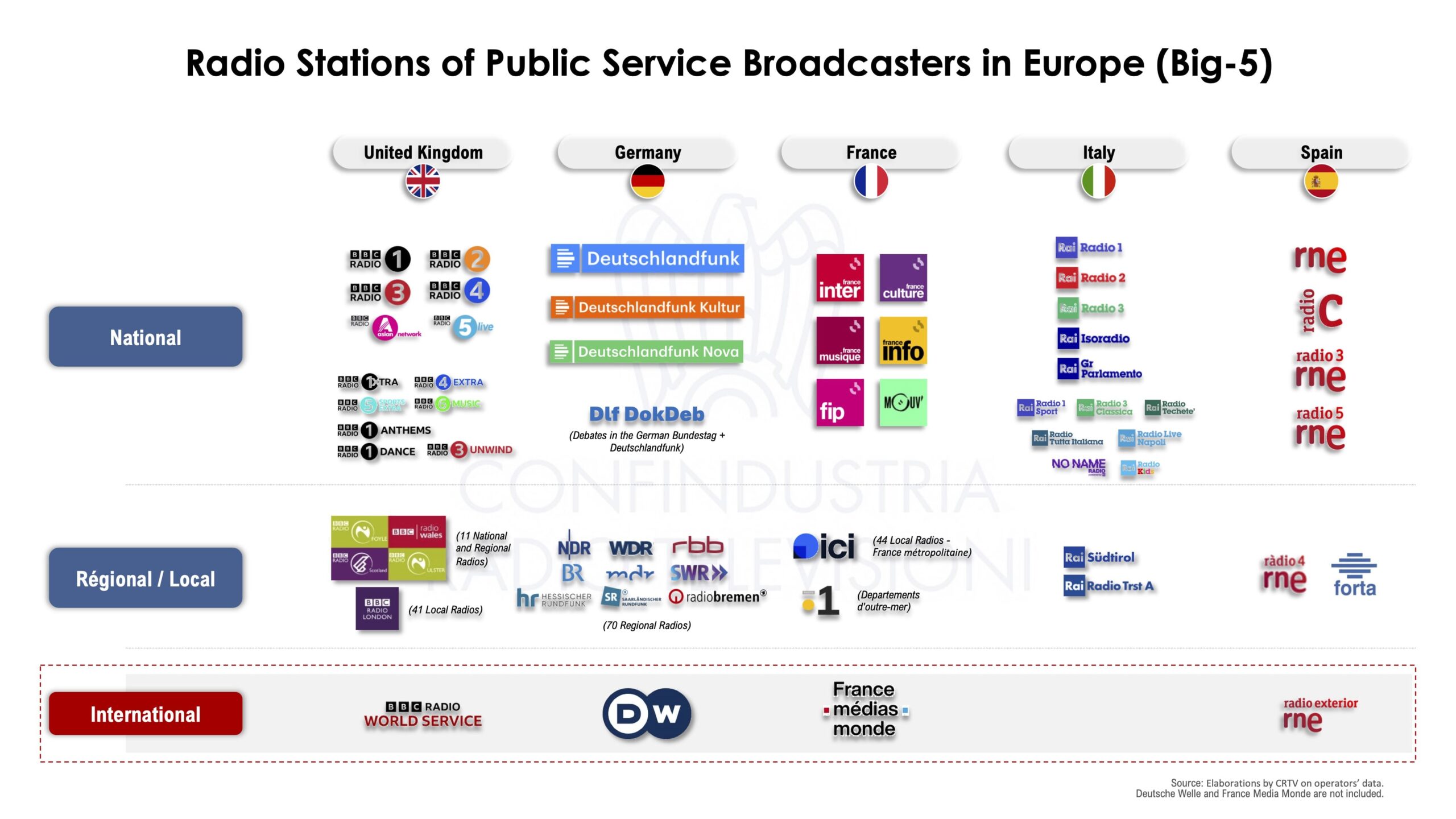
In general, the organization of public rtv services can also be analyzed according to the specialization/ uniqueness of the PSM entities with respect to the activities performed (radio, tv) and according to the territorial scope of such activities (national/local/international). The United Kingdom and Italy are characterized by a single PSM (BBC and Rai) covering all activities (radio, TV) in any territory (BBC is present internationally through BBC World Service).
By contrast, in Germany, France and to some extent Spain, several ‘specialized’ entities distribute their RTV activities nationally (Radio France, Deutschlandradio, RTVE), flanked by others for the regional/local level (ARD, FTV, Autonomous + Municipal Communities). In addition, France and Germany have further public entities, financed, in this case, directly by the State, which manage radio (and television) activities at an international level (Deutsche Welle in Germany and France Media Monde in France).
Most of the major radio operators analyzed in the European Big(5) markets appear to belong to multimedia groups ranging from print publishing to television (RTL, NRJ, Atresmedia, Prisa) and financial/advertising intermediation (Bauer Media, Global Radio).
In some cases, they also belong to sectors that are extremely distant in industrial/production terms from radio, as is the case of CMA CGM Group in France, an entity mainly focused on logistics and freight transport services which entered the media world in 2023, first with the acquisition of some local newspapers (La Tribune, La Provence, Corse Matin), and then, the radio and TV assets of Altice France in 2024.
On the contrary, in Italy there is a radio market populated mainly by purely radio operators (RTL 102.5, RDS, Radio KISS KISS, Radio Italia), which have been joined over the years by several still active publishing groups (GEDI, Gruppo 24Ore), the last of which Mediaset-MFE with several national and local brands between 2015 and 2018. This is the result of the Italian economic and social context in which commercial radio developed in the 1970s, in many cases as family-based entrepreneurial business.
Another factor that distinguishes the Italian radio market is the marginal international dimension of the groups to which they belong: all radio operators, apart from Mediaset, have, do not operate beyond national borders. Differently, in the other countries almost all the operators, directly or through other companies within their group, have activities in other European markets (Sweden, Norway, Poland, Denmark, Finland) or, as in the Spanish case, even overseas (Latin America), thanks to the diffusion of their mother tongue (Prisa). This is also true for radio broadcasting alone, in 8 out of 17 cases analyzed (Bauer Radio UK, Global Radio, Wireless Group, RTL Radio Deutschland, ENERGY Media, M6, NRJ, Prisa Radio).
Local broadcasting is also an important dimension for several private radio publishers in the UK (Bauer Radio UK, Global Radio), Spain (COPE, Atresmedia Radio, Prisa Radio) and Germany (ENERGY Media, RTL Deutschland), Italy (RDS, Radio Kiss Kiss, Radiomediaset).
Distribution and Development of DAB/DAB+. Over the last decade, the DAB standard has been improved by evolving into DAB+, which, thanks to the use of Mpeg-4 compression, allows more programs to be broadcast with the same bandwidth. The UK and Spain are still characterized by the presence of radios broadcast in DAB technology. In the last few years in the UK, numerous private commercial broadcasters have started to migrate to the new standard; in Spain, on the other hand, due to issues related to delays and lack of investment and, above all, willingness on the part of the system, including institutions and administrations, the transition is still unclear, also in the absence of a definitive regulatory framework on the matter.
As Digital Radio UK reports, 66 radio stations nationwide broadcast on DAB/DAB+, including commercial and public service stations: 23 stations or 35% adopt DAB standards and 47 (71%) are digital-only. At local level, there are 644 radio stations broadcasting on 58 muxes.
According to data reported by WorldDAB in 2023, cumulative sales of DAB/DAB+ digital devices in the UK are 55.6 million units, up 6.0% from the previous year (52.4 million). Overall, according to Ofcom’s DAB report, published in September 2023, the penetration of DAB+ devices in the UK is:
- 1 million households (36%) have a DAB+ device at home or in the car for an estimated total of 14.8 million DAB+ devices;
- 2 million households (15%) have a DAB+ set at home to an estimated 4.8 million DAB+ sets;
- Two-thirds of DAB homeowners (66%) also have a DAB+ set;
- More than one third of all households with a car (37%) have a DAB+ set in their car.
In Germany, ALM estimates, a total of 152 million radio reception devices, including hybrid models (IP/DAB+), are present in German households in the past year. Analogue FM devices still account for around 76% of the total (115 million units), but the number of DAB+ devices, is up by more than 4.4 million since 2022 (+18.4%), accounting for 28.3 million (20%) devices in total. Not only has the number of home devices increased, but also the number of car radios with a DAB+ interface, amounting to 11.5 million units in 2023. Overall, around a quarter of car radios are equipped with a DAB+ receiver (26%).
In France, 2.4 million radio sets were sold in 2023 (excluding pre-installed car radios, in new models), which corresponds to a 12% decrease compared to the previous year. Of all these receivers, about 430,000 are DAB+ compatible, a number comparable to that of 2022. The share of DAB+ receivers in total sales reaches 18%, compared to 15% in 2022. According to WorldDAB, the cumulative total number of DAB/DAB+ devices sold from 2008 to 2023 exceeded the 10.6 million marks.
In Italy, the latest data released by WorldDAB reports about 12.6 million receivers sold to date (indoor + automotive) with a penetration of 13% of homes. Another source, GFK Italy, estimates over 14 million receivers to be in use by 2024, mainly installed in cars and commercial vehicles. For Spain, not much data is available, on account pf the delayed adoption of DAB+: in terms of indoor penetration, almost 5% of digital radio receivers sold in retailers include a DAB/DAB+ receiver. The Spanish Automotive Association (Anfac) [3] published data on car and SUV registrations in Spain, certifying that in 2024, for the first time since the beginning of the pandemic, the one million car figure was exceeded, up 7.1 per cent year-on-year.
Noteworthy is the development of Small-scale DAB (SSDAB) in the UK, a technology first tested in 2012 and introduced by Ofcom between 2015 and 2018 in 10 areas. The trials, involving around 140 small-scale broadcasters, demonstrated the feasibility of new low-cost approaches to digital radio distribution. As a result, the government introduced a set of regulations allowing the Authority to grant licenses for new small-scale multiplex covering limited geographical areas, giving smaller commercial and community radio stations the opportunity to broadcast on DAB. Ofcom issued its first small-scale DAB multiplex licenses in March 2021 and has now completed five rounds (30 June 2023), with a sixth in progress (2024): 212 applications have been received for 167 areas, 115 licenses have been awarded and 64 multiplexes launched to date.
Radio Measurement and Audience. Electronic measurement offers advantages over methodologies that require respondents to actively remember or record what they heard, as they can provide highly accurate minute-by-minute data with minimal delay after the time of transmission and provide metrics in a similar way to television and online media. However, electronic measurements may have limitations, at least in terms of cost, when compared to diaries or telephone interviews: this means that sample sizes tend to be relatively small, which presents a challenge to accurately measuring audience for smaller and local radio stations. For this reason, countries such as Norway, Sweden and the United States maintain the active (declarative) methodology to measure local and smaller stations respectively. Only Switzerland has a meter only system. In France, since 2023, Médiamétrie has been carrying out automatic long term (7-28 days) audience measurement of national stations, where it shares the management of 5,000 meters with television.
The EGTA report as well as the EASI (Emro Audience Survey Inventory) report by EMRO (European Media Research Organisation) confirm that, while ‘declarative’ methodologies are still the most used throughout Europe, best practices at international level testify that the process of technological development is the way forward. Electronic metering (using meters) was first developed in Switzerland where it was introduced in 2001. The pilot of a PPM meter was tested in the UK in the late 1990s and introduced in larger markets in the US in 2007. The PPM methodology has proven to be the most widely adopted electronic radio audience measurement platform, currently in use in Canada, Denmark, Iceland, Kazakhstan, Norway, Singapore, Sweden and the United States. The French measurement company Médiamétrie has recently developed a similar technology called RateOnAir (watermarking). Convergent metering systems can also be found in the Dutch experience (NMO), which has initiated a cross-platform and cross-device metering system for all media, thus surpassing previous JICs.
So far the introduction of electronic measurement has been successful in those countries that have been able to find a common agreement within the radio industry, to translate the advantages of accurate and granular data and to gain acceptance of a new pricing structure by advertising buyers.
Recently, in the UK, Rajar (Radio Joint Audience Research) adopted a hybrid solution combining data collected from diaries and meters. In fact, in October 2021, the institute introduced a new methodology that adds to the existing system based on audience diaries, expanding its data collection sources with the inclusion for the first time of a panel with MediaCell technology (PPM technology) along with respondents recruited for personal interviews. This flexible and advanced methodology provides greater stability and security for future Rajar surveys, optimizing resources and creating a solid base for future development.
Similarly in the French market, Médiamétrie, which is the main body in charge of audience measurement of the various media (TV, radio, Internet, etc.), recently introduced a parallel measurement which combines the results of the declarative method with the data obtained from the electronic survey. In fact, Médiamétrie regularly publishes two main studies on radio audiences: EAR National, which surveys the average daily audience (Reach, Share and listening duration), and EAR Insight, which surveys listening behaviors over a long period (7 and 28 days).
Spain is also showing signs of updating. Thanks to the work of ODEC and the technical direction of AIMC, from the third wave 2024 onwards (September), the EGM includes the streaming/live internet audience of the main radio groups (36 networks), derived directly from their census consumption data (log server). [4]
Italy, with the transition from TER (Tavolo Editori Radio) to ERA (Editori Radiofonici Associati), which took place in April 2024, has undertaken an evolutionary path (also in terms of the organizational model, from MOC to JIC) [5] with the birth of the new Audiradio and the launch of the new radio survey 2025, including on-demand content on personal computers, mobile phones, tablets, apps and smart TVs (SDK technology).
Passive detection models can also be found outside Europe. For example, in Canada a similar model has been replicated which provides for the use of profiling data in aggregate form from the Telcos operating in Canada, to further increase the accuracy of the measurements, in consideration of the pre-eminent public and systemic function that the government has recognized to the JIC.
In almost all the countries monitored, traditional linear listening, to a greater or lesser extent, has shown a downward trend over the last decade, accompanied by an expansion of the more mature age groups, to the detriment of the younger ones, increasingly oriented towards streaming audio services (music and podcasts).
In 2023, approximately 49.5 million individuals aged 15+ (87.9%) listen to radio in the UK during the week. The figure updated to Q2 2024 shows an even higher consumption, the highest in 20 years of 50.8 million listeners (+2.7% compared to Q2 2023) and a reach of 88.2% of the entire population. Total listening hours also increased from 1.013 million hours in 2023 to 1.048 in Q2 2024 (+25 thousand compared to Q2 2023) with the average duration per listener remaining almost stable (20.6 hours per week).
In Germany, according to Agma’s survey for the period September 2023 – March 2024, [6] approximately 53 million German-speaking individuals (75.1% of the total population, aged14+) listen to at least one audio-radio offer (Audio Total), [7] daily, from Monday to Friday, regardless of reception mode, with an average duration of approximately four hours (248 minutes). In four weeks, the listening range rises to 65.6 million with a coverage of 93.1% of the population (but 2024 Audio I: 93.7%). The 2024 data are in line with those of the previous wave (ma 2024 Audio I, December 2022 – December 2023): the average daily consumption recorded 52.5 million individuals (75.0% of the total population 14+) with a listening duration of 245 minutes.
Despite the contraction over the last 10 years (-10.2%), linear radio listening on all platforms (FM/DAB+/Online) still represents the largest share of total audio-radio consumption: in 4 weeks, ‘92.5% of the population (65.2 million individuals) listen to classic’ radio and 73.9% (52.1 million) on the average day with a 248-minute dwell time (2023: 73.8% / 246 minutes).
In 2023, there are approximately 39.0 million average daily listeners in France, representing 70.2% of the population, down 1.5% from the previous year, with a listening time per individual of 2 hours and 40 minutes. In the long term (2014- 2023), listening declined by 9.7% with a loss of 4.18 million individuals in absolute terms.
In Italy, according to data released by the TER survey, in 2023 listeners on the average day were 36.3 million (70% of the 14+ population) 44.7 million (86%) on seven days amounted to. Extremely significant year-on-year results for both indicators (+7.5% on the average day, +3.1% on the seven days, compared to 2022), but probably conditioned by the ‘self-promotion advertising campaign’ adopted by many broadcasters and interrupted by communication from TER in the second half of the year. Growth can also be seen in terms of listening time with 223 minutes (+13 minutes). In contrast, in the first half of 2024, the figure, while still significant, stabilized at 35.3 million (68% of the 14+ population) on the average day and 44.5 million (85%) on 7 days. In the latest survey, the average listening time was 209 minutes, in line with the values of the first half of 2022.
Finally, in Spain, listening time dropped slightly to 93 minutes, (they were 94 in 2022); the radio audience grew, in absolute terms, by 269 thousand new listeners (+1.2%), reaching a total of about 22.6 million individuals at the end of the year, 54.3% of the population aged 14+.
CAR FOCUS. Overall, in-car radio listening (FM/DAB+) remains important in many countries, although the number of individuals connecting their devices to access various streaming services is growing.
In the UK, according to Rajar, radio listening takes place at home in 2023 (63%) followed by 57% in cars or other commuting vehicles. DAB accounts for most of the in-car radio consumption with a 57.5% share, followed by analogue AM/FM (35.8%); online radio, which has remained stable in the past three years, stands at 6.7%. In 2024 an Ofcom commissioned In-car Audio Survey of British drivers and/or passengers who drive at least once a week found that two-thirds of respondents (67%) connect their device to their car, using Bluetooth as their primary connection method (53%). This percentage increases significantly among younger age groups (80% of 25–34-year-olds).
In Germany, around a quarter of car radios are now equipped with a DAB+ receiver (around 11.5 million). This number is more than ten times higher than ten years ago (Audio Trends 2023-2024). This result is also accompanied by a change in consumer habits, with almost 80 per cent of Germans with a DAB+ interface in their car stating that they listen to digital radio more. The number of car radios rises to 30% if we include pure/hybrid models with an IP interface. According to the Online Audio Monitor (OAM), in 2024, around 28.7 million individuals, i.e. four out of ten people aged 14 years and over (41%), listen to digital audio content in the car (up from 38.7% in 2023): listening among young people under 30 will increase from 50.1% in 2023 to 60.3% in 2024 (+10.2 p.p.). Among users listening to digital audio content in the car, radio (FM/DAB+ and IP) continues to be the most used audio format (77%). Radio or audio content is accessed predominantly through the car radio or infotainment system (92.4%, +1.7 p.p. compared to 2023): almost two-thirds (64.1%) directly more than half (55.4%) via a connected smartphone or tablet.
In France, Arcom’s Observatoire de l’équipement audiovisuel des foyers certifies the decline, over the last 10 years (2014-2023), of the penetration of all radio equipment except for car radios, which remains above 70%. According to Médiamétrie, in 2023, car radio (FM/DAB+) remains the main medium for radio listening with a penetration of 77.4%, of which 17.6% is DAB+ compatible. In terms of listening time, the share of time spent outside the home is 50%, mainly in the car with 34%. The latest Global Radio survey reports that the FM car radio remains the most used device by the French with 48.6% of individuals.
In Italy, research conducted by GFK Italia estimated that over 14 million receivers to be in use by 2024, mainly installed in cars and commercial vehicles. However, despite the increase, users’ coverage remains insufficient. These figures highlight that widespread DAB+ deployment and market maturity has still to come. AINFA and WORLD DAB data show that the nationwide penetration of DAB+ in cars has increased from 11.6% in 2019 to 23.6% in 2023.
In the last year, listening via car radio (source: TER) has confirmed its position as the most widespread mode with over 25 million individuals (72.5%). As regards listening to digital broadcasts in the car, again according to GFK, in 2024, on a panel of 1,200 owners of DAB+ car radios, it emerges that 81% listen to DAB+ exclusively or in overlap with FM, of which 13% listen exclusively to DAB+, 27% listen mainly to DAB+, 41% listen equally to DAB+ and FM, and 19% listen mainly to FM. In the last year, listening via car radio (source: TER) has confirmed its position as the most widespread mode, with over 25 million individuals (72.5%).
Finally, in Spain, in 2023, the car is the second “environment” for radio listening (after the home), with a slight increase from 25.3% in 2022 to 25.8% in 2023. In terms of share, domestic consumption covers half of the minutes of listening (50.2%) while in the car a quarter (25.4%). In the last year, the Spanish Automotive Association (Anfac) certified that the number of registrations of cars with FM/DAB/DAB+ radio receivers has reached a total of 3.6 million units since 2021.
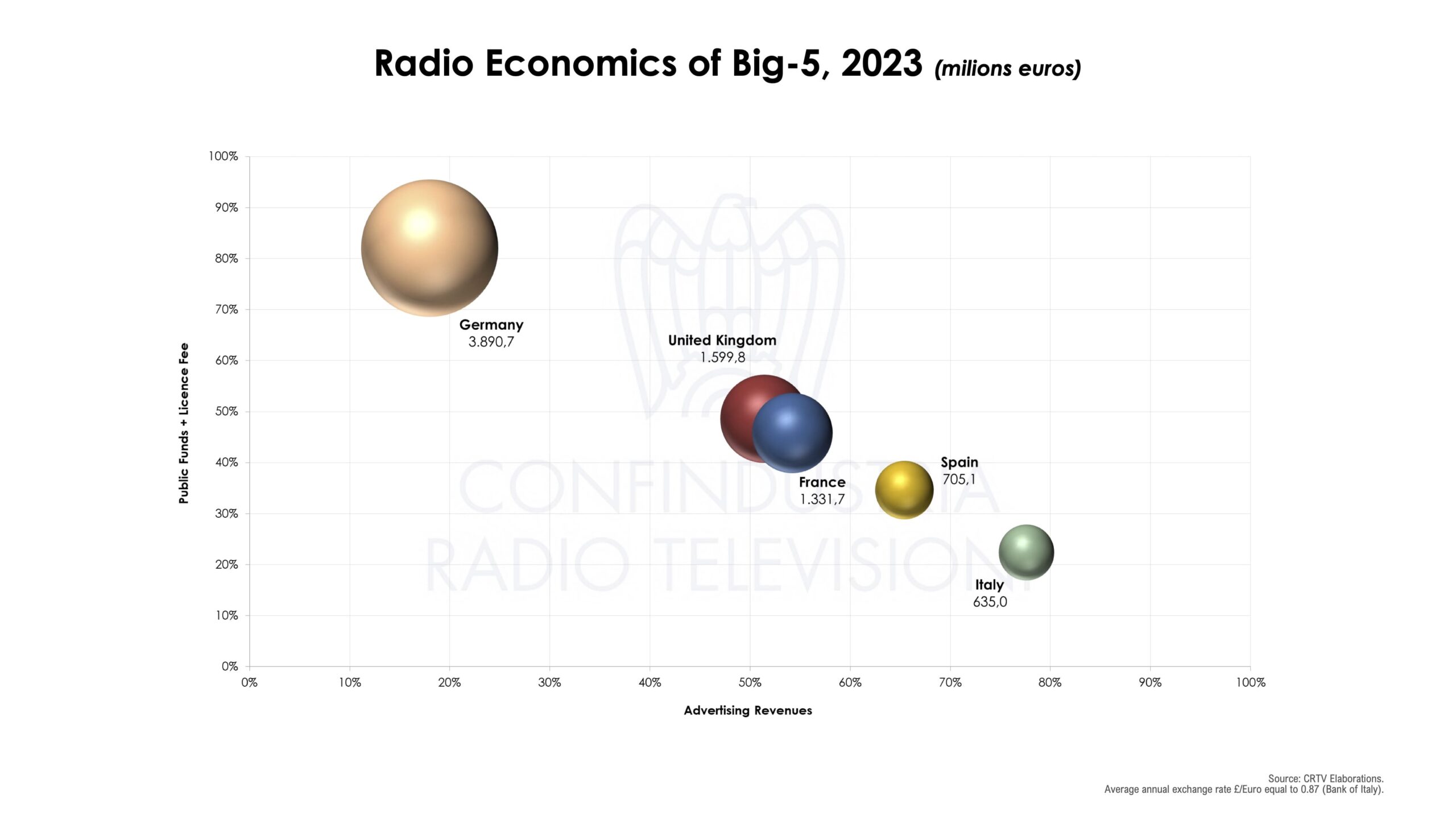
Radio Economics and Audio-radio Ecosystem. The most important radio market in terms of resources is Germany with approximately EUR 3.9 billion, up 2.7% year-on-year (+ EUR 102 million). The license fee component, consisting of the fees of Deutschlandradio and the state bodies (ARD) is confirmed the main source with 82% (EUR 3.2 billion), with advertising revenue accounting for the remaining 12% (EUR 700 million).
In 2023, the new audio-radio ecosystem, which aggregates the sources to which the different segments refer (music, radio, audio-book publishing and podcasts), reached a total value of EUR 13.8 billion (total Big-5). In detail, Germany exceeded the threshold of EUR 6.1 billion with radio representing the most important segment (EUR 3.9 billion equal to approximately 63% of the total), even compared to other countries, followed by digital music (streaming + download) with over EUR 1.6 billion (27.3%); music recorded on physical media stands at EUR 344 million (5.6%) and digital audio content (podcasts + audio books) at approximately EUR 233 million (3.8%).
In the UK, the new ecosystem exceeded a total value of EUR 3.3 billion. Radio remained confirmed in its position as the most important sector with a 48.4% share of the total (EUR 1.6 billion), followed by digital music (streaming + downloading) with over EUR 1.1 billion (34.4%). The picture was completed by music recorded on physical media with EUR 280 million (8.5%) and digital audio content (podcasts + audiobooks) with around EUR 290 million (8.8%).
In France, the economic resources of the radio system represented by advertising and public funds allocated to the public service operator (mainly Radio France) amount just over EUR 1.3 billion, up 5.8% annually. The audio-radio ecosystem totals around €2.2 billion, up 4.6% year-on-year (approximately +100 million). Radio has therefore gained a share of 60.8% of the total, confirming its position as the most important sector in this country, followed by digital music (streaming + download) with approximately €600 million (27.7%); recorded music on physical media closed with €195.0 million (8.9%) and on-demand content (podcasts + audio books) with approximately €58.0 million (2.6%).
In Italy, the economic resources of the radio sector, both national and local, according to the perimeter described by the Communications Regulatory Authority (Agcom), stood at EUR 635 million in 2023, with an increase of approximately EUR 30 million (+4.9%) compared to 2022. Advertising revenues (78% of total resources), grew by 7.1%, exceeding the threshold of 490 million euros. The share of fees relating to radio activities stands at €90 million (14% of total resources) [8] while public agreements and public contributions amount to approximately €53 million (-3.3%). As regards the audio-radio ecosystem (FM, DAB+, Online), the value for 2023 slightly exceeds the threshold of one billion euros (+8.3% compared to the previous year). Radio reaches a share of 61.9% of the total and confirms itself as the most important sector, followed by digital music (streaming + download) with approximately EUR 283 million (27.5%). The ranking is closed by music recorded on physical media closes the picture, with EUR 62 million (6.0%) and digital audio content (podcasts + audiobooks) with approximately EUR 47 million (4.6%).
In Spain, the economic resources of the radio sector, national and local, amounted to approximately 705 million euros, an increase of around 30.0 million euros (+4.4%) compared to 2022. In 2023, the total economic value of the audio-radio ecosystem (FM, DAB+, Digital) is approximately EUR 1.14 billion (+7.8% year-on-year). Radio with approximately EUR 700 million remains the most important segment (62.0% of the total), followed by digital music (streaming + download) with approximately EUR 353 million (31.1%). To complete the overall picture, recorded music on physical media accounted for 51 million (4.5%) and digital audio content (podcasts + audio books) approximately 26 million (2.3%). complete the overall picture, music recorded on physical media represented 51 million (4.5%) and digital audio content (podcasts + audiobooks) with approximately 26 million (2.3%).
Updated: Apr 14, 2025
METHODOLOGY AND SOURCES
The study was launched on the 100th anniversary of radio in Italy, on 6 October 2024, to describe the state of the art on the longest-running industry among broadcast media, extending the vision beyond national borders to the main European countries (Big-5).
The collection and cross-analysis of the different sources represented the most significant phase of the work, followed by a harmonization process of not always possible between data within the same market, with the objective of providing a snapshot as exhaustive and comparable as possible based on certain areas of in-depth analysis and reference indicators.
The sources are multiple and range from those of an economic and legislative nature coming from state bodies – regulatory authorities (Der Runndfunkbeitrag, Ofcom, Arcep, Arcom, CNMC, Agcom) and recognised bodies within the markets (Rajar, Médiamétrie, Agma, EGM), to the consultation of balance sheets and annual reports of radio operators and the main trade associations (Radiocentre, Vaunet, Promusicae, FIMI, SIRTI, Radio Bureau, IAB, Udecam, ZAW).
Added to this are estimates and information of various types developed by specialized research companies and agencies (Mindline Media, PwC, Polimi).
As in the previous CRTV Study, focused on the Italian market, we tried to represent the audio-radio ecosystem where different areas of the so-called aural attention economy converge (radio, recorded music, podcasts, audiobooks), segments still vertically structured and distinct by editorial logics, indicators and metrics, and therefore not yet fully comparable, and not always economically quantifiable.
Note:
[1] The first two (private) stations to broadcast in Spain were Radio España, inaugurated on 10 November 1924, and Radio Barcelona, now Cadena SER, four days later. The start of Spanish broadcasting is also made to coincide with the issuing of the Real Orden of 14 June 1924.
[2] Rai broadcasts Rai Radio Südtirol in the Trentino-Alto Adige region in German and Italian; Rai Radio Trst A in Italian and Slovenian in the autonomous region of Friuli-Venezia Giulia, in Slovenian Istria and in Croatian Istria.
[3] Asociación Española de Fabricantes de Automóviles y Camione.
[4] The project starts with the participation of 36 radio stations from the following media groups: PRISA (SER), Ábside Media (COPE), Atresmedia (Onda Cero), 3Cat (Catalunya Radio), Grupo GODÓ (RAC1), RTVA (Canal Sur), KISS (Kiss FM), Radio MARCA, RTVE (RNE), Grup FLAIX, Esradio.
[5] TER had started discussions with UPA and UNA, as requested by Agcom in Resolution No. 202/23/CONS, to transform the research from MOC (Media Owners Committee) to JIC (Joint Industry Committee.
[6] ma 2024 Audio II, July, the 17th 2024, AGMA.
[7] Listening to at least one audio-radio offer between classical radio (FM/DAB/Online), streaming services and UGC content.
[8] Agcom estimate.
